Overview
Pre-filled syringes (PFS) of push-dose vasopressor medications are provided in the main resus medication press.
They are also stocked in the RSI drug boxes:
- Metaraminol minijet (2.5 mg/5 mL) x 2
- Phenylephrine minijet (0.5 mg/10 mL) x 1
NB - post-intubation HYPOtension is the commonest adverse event in critical care intubations and is clinically significant for worse outcome; have the RSI box open, pressor to hand.
| PFS | 2.5 mg/5 mL |
|---|---|
| Adult bolus | 1-2 mL |
| Paed bolus | 0.01-0.02 mL/kg |
| Frequency | Q1-2 min |
| Onset | 1-2 min |
| Duration | 20-60 min |
| PFS | 500 µg/10 mL |
|---|---|
| Adult bolus | 2-4 mL |
| Paed bolus | not appropriate |
| Frequency | Q2-5 min |
| Onset | 1 min |
| Duration | 10-20 min |
Metaraminol (0.5 mg/mL)
- Preferred first-choice push-dose pressor in most scenarios
- Standard concentration PFS: 2.5 mg in 5 mL
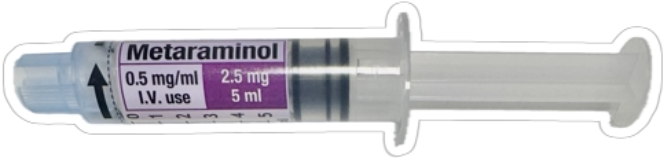
- Indirect and direct ino-pressor effects:
- Direct effects:
- α1 adrenergic receptor agonist: causes vasoconstriction
- Mild β-agonist
- Indirect effects:
- Stimulates noradrenaline & adrenaline release from intracytoplasmic stores*
- Direct effects:
- Pure α-agonist: ↑SVR → ↑PREload (+ ↑Contractility) → ↑MAP
- Indication: acute ↓BP (from either low vascular tone or poor contractility) - e.g. post-intubation vasodilatory hypotension
- Onset: 1-2 minutes (peak 10 minutes)
- Duration: 20-60 minutes (indirect effects)
Bolus Dosing
10 micrograms/kg (0.02 mL/kg), Q1-2 minutes, i.e.:
- Adults: 1-2 mL (0.5-1 mg)
- Children: 0.01-0.02 mL/kg (5-10 µg/kg)**
e.g. maximum bolus: 10 kg infant: 0.2 mL; 25 kg 8-yr-old: 0.5 mL
For adults, one syringe may only yield 2-3 doses… if two syringes are needed, start a peripheral Noradrenaline infusion before using the last dose - see Critical Care Infusion Stickers.
- *For late-presenting or severe critical illness, patients may not respond well due to exhausted endogenous catecholamine stores (or direct adrenal damage). In this scenario, consider phenylephrine PFS (see below) whilst moving rapidly to peripheral Noradrenaline infusion - see Critical Care Infusion Stickers.
- **Push-dose pressors are only rarely needed in paediatric resuscitation - first line is always generous fluid bolusing, which most children respond well to.
Phenylephrine (50 µg/mL)
- Pure, powerful vasopressor with risk of inducing bradycardia
- Low concentration PFS: 500 µg in 10 mL - ½ the concentration of the standard infusion
- This ‘minijet’ PFS is now the only phenylephrine preparation to be used for push-dose in ED
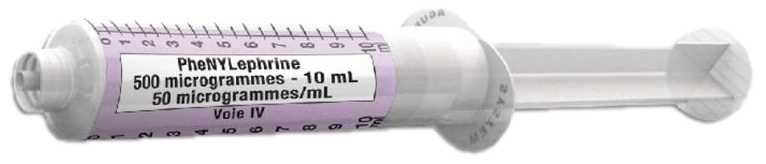
- Pure α-agonist: ↑SVR → ↑PREload → ↑MAP
- No intrinsic chronotropy (no ↑HR), or inotropy (though ↑coronary perfusion may ↑contractility)
- Causes reflex BRADYcardia + ↑AFTERload, which can ↓cardiac output in some hearts
- Indication: ↓BP + ↑HR (or without bradycardia) - e.g. septic or neurogenic shock, peri-intubation, tachydysrhythmia with ↓BP
- Onset: 1 minute
- Duration: 10-20 minutes
Bolus Dosing
2 micrograms/kg (0.04 mL/kg), Q2-5 minutes, i.e.:
- Adults: 2-4 mL (100-200 µg)
Not appropriate for use in children (++ risk of inducing reflex bradycardia and thus ↓CO).
One syringe may only yield 2-3 doses… if more needed, start continuous infusion, or switch to peripheral Noradrenaline infusion - see Critical Care Infusion Stickers.
Links
- https://emed.ie/Crit-Care/Infusion_Stickers.php - Critical Care Infusion Stickers (peripheral Noradrenaline)
- https://emed.ie/Pharmacology/IV_Admin.php