Initial Management
Analgesia
Burns can be extremely painful — analgesia will be essential for adequate assessment and management
Consider IN fentanyl or IV morphine during assessment, cooling, dressing and mobilisation
First Aid
Remove any clothing/jewellery in contact with the burn
Cooling the affected area is the single most important element of burns care — cool running water is the best method to achieve this
- Run under cool water for 20 minutes, within 3 hours of the time of burn
- Alternatives include frequently changed cold water compresses, immersion in a basin, or irrigation via an open giving set
- Burn gel should not be used if any of the above are available
- Do not apply ice
- Some chemical burns require specific irrigation — contact the National Poisons Information Centre for assistance: 01 809 2566
Appropriately consented photographs of burns prior to dressing are useful for ongoing management
Dress burns with Jelonet or Mepitel, covering the entirety of the burn
- If these non-adhesive dressings are unavailable (e.g. prehospital management), plastic cling film can be used lengthways (do not wrap circumferentially) in the interim
Further Management
Prevent hypothermia
Give tetanus toxoid if the child's immunisations are not up to date per the childhood vaccination schedule
Prophylactic antibiotics are not indicated in the acute management of a burn
History
Time of burn
Mechanism of burn
- Scald: estimated temperature and nature of the liquid.
- Contact: estimated temperature and nature of the surface.
- Friction: enquire about circumstances.
- Flame or explosion: product/material that burned/exploded; location (enclosed vs. open space); duration of exposure; concerns for inhalation injury.
- Electrical: voltage, type of current (AC or DC), duration of contact.
- Chemical: type of product?
- Cold: direct contact with cold surface or exposure (frostbite).
- Radiant: sunburn
First aid received (time started, agents used, decontamination if chemical)
Consider co-existing non-burn injuries
Consider NAI (non-accidental injury)
Examination
Airway
- Burn/inhalation injury? Look for stridor, hoarseness, black sputum, respiratory distress, singed nasal hairs, or facial swelling
- Burns to the neck? Consider early intubation
- If evidence of airway burns, CO intoxication, or inhalational injury — apply high-flow oxygen
Breathing
- Full thickness/circumferential burns may require escharotomy
Circulation
- Two points of access required — IV or IO
- If shock develops early, consider other causes
- Check peripheral perfusion with circumferential burns — may require escharotomy
Disability
- Isolated burns
do not cause altered consciousness - if decreased or altered consciousness, hunt for other causes (trauma, intoxicant, chemical toxicity)
Exposure
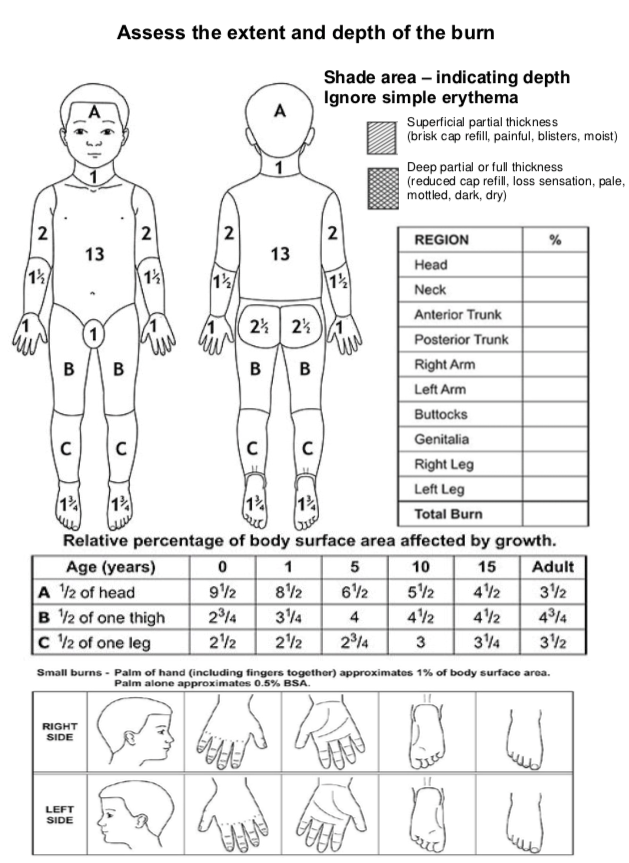
- Remove clothing and log-roll to visualise posterior surfaces Assess Total Body Surface Area (TBSA) using the Lund–Browder chart
Lund-Browder Chart
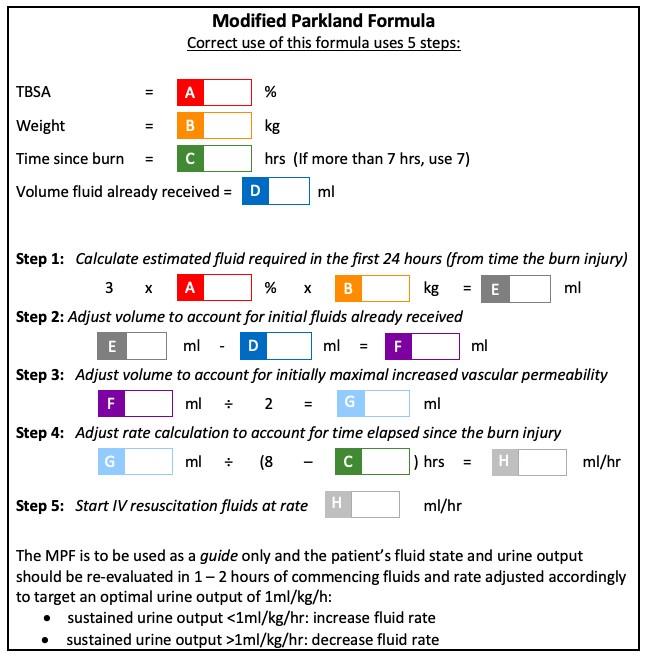
Fluid Management
Calculate requirements from the time of the burn, not the time of presentation.
1. Resuscitation Fluid (IV Hartmann's) — Modified Parkland Formula
- First half given within 8 hours of the injury
- Second half titrated over the subsequent 16 hours, according to urine output
Volume required in the 24 hours post-injury = 2 mL × weight (kg) × %TBSA
Divide by 2:
2. Maintenance Fluid (0.9% NaCl / 5% Dextrose)
- Indicated in all burns >15% TBSA
- Can be given orally or IV — no need for IV fluids if oral intake is adequate
- Run through a separate line from resuscitation fluid
- 24-hour maintenance fluid calculated as:
- 100 mL/kg for the first 10 kg
- 50 mL/kg for the next 10 kg
- 20 mL/kg for each kg thereafter
Referral to Paediatric Burns Service, CHI
Paediatric burns are managed locally by Plastic Surgery in CUH, who should be involved (either for ongoing management or a shared decision to transfer to CHI) if any of the following apply:
- ≥4% TBSA
- Full-thickness burn of any size
- Circumferential burn
- Associated trauma and/or spinal cord injury
- All inhalation/airway burns
- Special areas: hands, feet, face, perineum, genitalia, or flexor surfaces of joints
- Chemical burns
- Electrical burns
- Cold thermal/frostbite burn
- Unwell/febrile child with a burn, or concern for toxic shock syndrome
- Comorbidity that may affect treatment or healing (e.g. immunocompromise, T1DM, chronic renal disease)
- Suspicion of non-accidental injury
If referring to Plastics for ongoing management, dress wounds with a non-adherent silicone dressing (e.g. Mepitel, Adaptic Touch) and overlying wound gauze.
Patients requiring transfer to the CHI Paediatric Burns Unit require:
- Primary survey, evaluation for associated injuries, and stabilisation prior to transfer
- Review from Plastic Surgery in CUH
Special Considerations
Chemical Burns
- Discuss decontamination with the NPIC (available 24/7 on 01 809 2566)
- Remove all contaminated clothing
- Strict PPE
- Chemical irrigation/decontamination can take significantly longer than standard cooling — continue until skin pH is 7
- If irrigating, do not allow rinsing water to flow over uninjured skin
- Diphoterine (an amphoteric neutralising irrigation agent) is available in Resus, if required
- Do not irrigate dry lime, phenols, muriatic acid, concentrated sulphuric acid, or elemental metals with water — follow chemical-specific instructions
- Be aware that some chemical burns (e.g. hydrofluoric acid) can result in systemic toxicity
- Hydrofluoric acid burns (<1% TBSA) can cause systemic fluoride toxicity, depleting calcium and magnesium
- These patients should be kept in Resus, on continuous cardiac monitoring
- After irrigation, apply topical calcium gluconate every 15 minutes until the pain has stopped, then 4-hourly thereafter
Electrical Burns
- Liaise with Plastics and PICU
- Inspect for entrance/exit wounds
- Low threshold for trauma protocol
- Cardiac monitoring required if unconscious, in cardiac arrest, or with abnormal rate/rhythm
- Monitor for compartment syndrome — elevate affected limbs
- Monitor CK and urine for haemoglobinuria/myoglobinuria
Cold Thermal Burns / Frostbite
- Prioritise systemic hypothermia and trauma management
- Rewarm in circulating water at 37–39°C for at least 30 minutes, within 12 hours of injury
- Continue until tissue has regained sensation, feels soft and pliable, with a red-purple appearance
- Do not use dry heat or apply pressure/rub the area
- Elevate to prevent oedema
Ocular Burns
- Urgent ophthalmology review
- Signs include blepharospasm, tearing, conjunctivitis
- Irrigate with copious 0.9% sodium chloride and topical anaesthetic
- Topical chloramphenicol to prevent secondary infection
- All facial burns should be assessed with 2% fluorescein eye drops to check for corneal damage
Links
- Acute Management of Paediatric Burns - Print Version