Background
This pathway outlines the assessment and management of patients presenting to Cork University Hospital (CUH) with a suspected scaphoid fracture.
Fracture Location and Risk
The location of a scaphoid fracture has important implications for healing. Proximal pole fractures carry a higher risk of avascular necrosis (AVN) and non-union due to the predominantly retrograde blood supply to the scaphoid.
In contrast, distal pole fractures have a more favourable blood supply and therefore carry a lower risk of AVN and non-union.
Mechanism of Injury
- Fall onto an outstretched hand (FOOSH)
- Wrist hyperextension
- Axial loading through the thumb
- Direct trauma to the wrist
Clinical Examination
- Anatomical snuffbox tenderness
- Scaphoid tubercle tenderness
- Pain on axial loading of the thumb
- Wrist range of motion
- Grip strength
- Distal neurovascular examination
- Assessment for associated injuries
Investigation
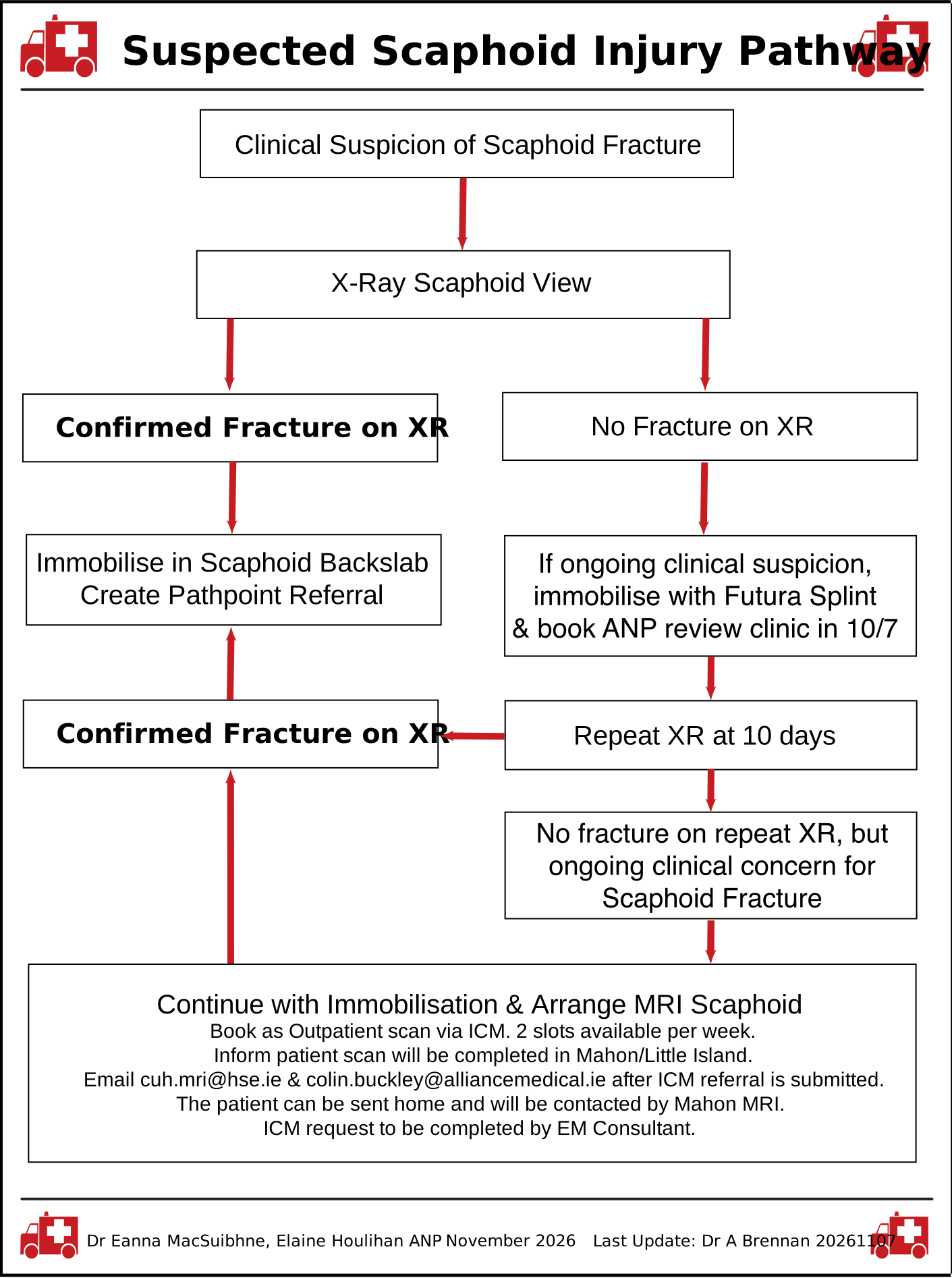
MRI Pathway
If patient is deemed to require MRI at ANP Review Clinic, they can be referred to the Mahon MRI Department via ICM – state “Scaphoid Injury Pathway” in imaging request. Once ordered on ICM, email CUH.MRI@hse.ie & colin.buckley@alliancemedical.ie to flag request.
MRI will be completed in the Mahon MRI department within 5 days of referral.
Referrer Notes
- This pathway can facilitate 2 referrals per week.
- All patients require screening questionnaire before referring for MRI.
- This pathway is only suitable for patients who agree to undergo scanning offsite in Mahon (not valid for CUH – patients who decline Mahon will be added to the general outpatient waiting list).
See MRI Scaphoid Pathway Protocol for further information.